Buying an air conditioner in Nepal usually comes down to two questions: how big, and inverter or not. Get the size wrong and the AC either runs flat out all afternoon or cycles on and off in a room it overpowers. This guide walks through both decisions using the split ACs we supply as worked examples.
What "1 ton" actually means
AC tonnage is a measure of cooling capacity, not weight. One ton equals 12,000 BTU per hour, or about 3.5 kW of heat removed from the room. Our ULTRA 1 ton models are rated at 12,000 BTU/h and the 2 ton model at 24,000 BTU/h. A higher tonnage moves more heat per hour, so it cools a bigger room or a hotter one.
Sizing by room
As a starting point for a normal room with a standard ceiling height:
- 1 ton: bedrooms and small offices, roughly up to 120 to 150 sq ft.
- 1.5 ton: larger bedrooms, living rooms and shops, roughly 150 to 250 sq ft.
- 2 ton: large living rooms, halls, clinics and showrooms, roughly 250 to 400 sq ft.
Move up a size if the room is on the top floor under a concrete roof, has large west-facing windows, is in the Terai where afternoon temperatures stay high for weeks, or regularly holds many people or heat-producing equipment. A kitchen-facing room or a shop with an open door also needs more capacity than its floor area suggests.
Inverter vs fixed-speed (ON/OFF)
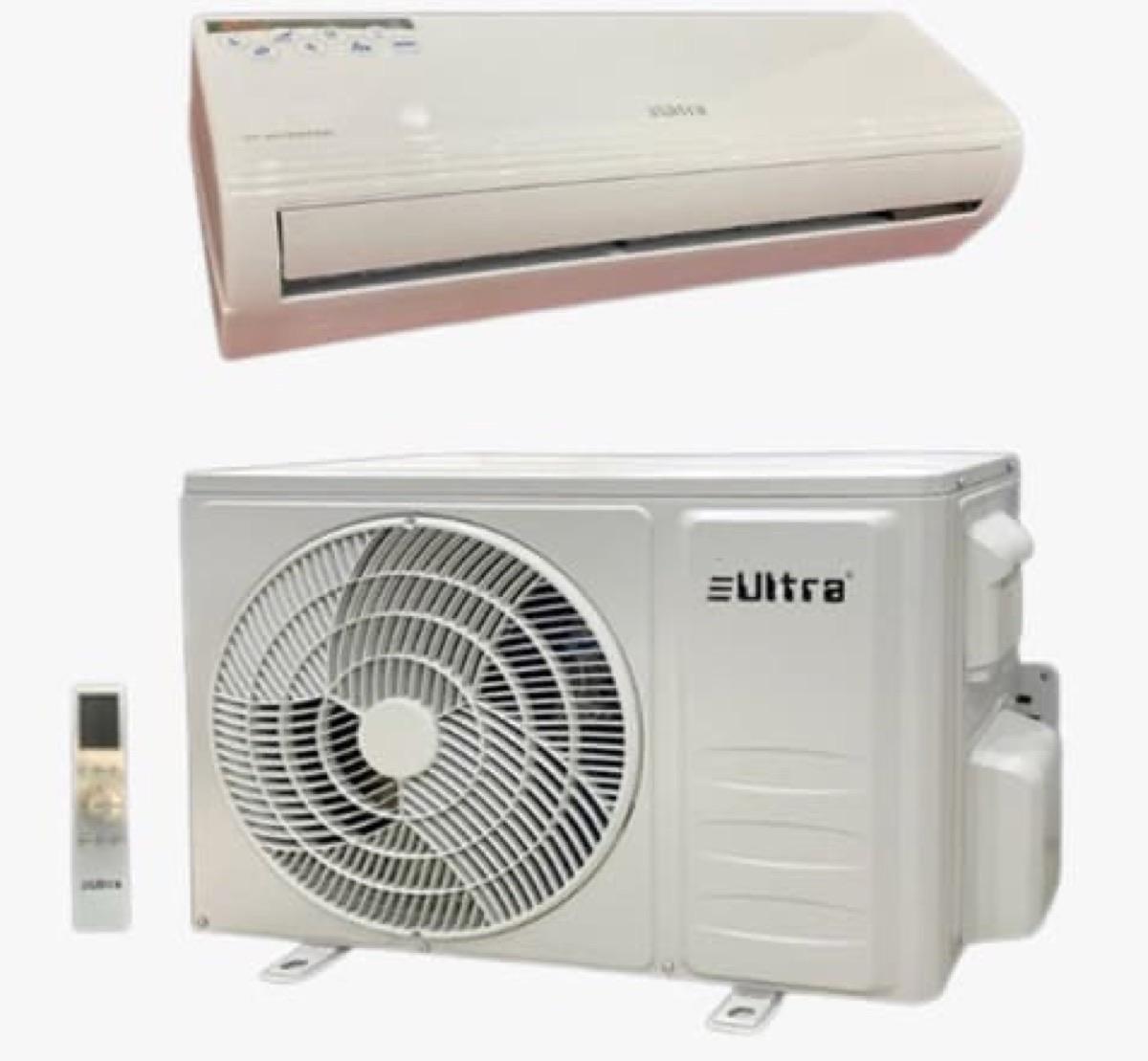
A fixed-speed AC, like our ULTRA UTACNOF12, has a compressor that is either fully on or off. It cools the room to the set temperature, switches off, waits for the room to warm up, then starts again at full power. An inverter AC, like the ULTRA UACINV-PREMIUM range, varies its compressor speed instead. Once the room reaches temperature it slows down and keeps running gently rather than stopping and starting.
Look at the rated figures and the two seem similar: the 1 ton ON/OFF model draws 1220W at full cooling and the 1 ton inverter model 1280W. The difference shows up over a long day. The inverter spends most of its time below full power, while the fixed-speed unit keeps returning to full power. The more hours you run the AC, the more an inverter saves, and the steadier the room temperature feels. If you only cool a room for an hour or two in the evening, the gap is small and a fixed-speed model is a reasonable budget choice.
Most split ACs here also heat
The ULTRA 1 ton and 2 ton models list a heating capacity equal to their cooling capacity: 12,000 BTU/h and 24,000 BTU/h. In heat mode the AC works as a heat pump, moving heat from outdoor air into the room, which uses far less electricity than a fan heater or oil heater giving the same warmth. For Kathmandu, Pokhara and other hill towns this makes one AC useful in both summer and winter.
Other things worth checking
- Noise: indoor noise is listed in dB(A). Our 1 ton inverter is rated at 42 dB(A) and the 1 ton ON/OFF at 45 dB(A); lower is quieter, which matters in bedrooms.
- Air volume: listed in m³/h; it tells you how strongly the indoor unit circulates air.
- Extras: the 2 ton model adds WiFi control and a self-cleaning function. Useful, but choose the right tonnage first.
- Wiring: a 2 ton AC draws around 2 kW, so it should have its own circuit and a socket rated for the load. We check this during the site visit.
Installation matters as much as the model
A split AC is only as good as its installation: the indoor unit needs clear airflow, the outdoor unit needs shade and ventilation, and the copper piping must be sealed and vacuumed properly so the refrigerant charge is right. Keep the run between indoor and outdoor units short where possible, and clean the indoor filter every few weeks during heavy use.
Compare 1, 1.5 and 2 ton ULTRA inverter and fixed-speed models on the AC price page, or contact us with your room size and location and we will recommend a tonnage and quote installation.