Most houses in Nepal sit behind a boundary wall with a heavy steel gate, and someone has to get out of the car to open it, in monsoon rain, at night, every day. An automatic gate motor fixes that, but the first decision is not the brand or the price. It is whether your gate slides or swings, because that decides which kind of motor you can use.
How the two types work
A sliding gate motor sits beside the gate and drives it along a track using a gear rack: a toothed rail fixed along the bottom of the gate that the motor's pinion gear pushes. The gate slides parallel to the wall.
A swing gate motor uses arms mounted on the pillars to push one or two gate leaves open like a door. It needs clear space behind the gate for the leaves to swing into.
Which one fits your gate
- Short or sloping driveway: choose sliding. A swinging leaf can scrape a slope or hit a parked car.
- No space behind the gate: choose sliding, as long as there is wall space for the gate to slide along.
- Existing double-leaf gate with open space behind it: choose swing. It works with the gate you already have.
- Very heavy steel gate: usually sliding, because the motor only has to roll the weight, not hold it on hinges.
The simplest rule: automate the gate you already have. Converting a swing gate to sliding, or the other way round, means fabrication and civil work that often costs more than the motor.
Sizing a sliding motor by gate weight
Heavy gates need a stronger motor. Our Everest Series sliding motors are sized by the gate weight they can move:
- Everest 370W: gates up to 800 kg, most residential gates
- Everest 550W: up to 1,200 kg, medium-sized gates
- Everest 750W: up to 1,600 kg, heavy gates
- Everest 1200W: up to 2,500 kg, commercial and industrial gates
- Everest DC: up to 1,500 kg, and compatible with battery backup
- Italian-designed: up to 1,000 kg, with soft start, soft stop and a pedestrian mode
If you do not know your gate's weight, measure its width and height and tell us the steel section used. We confirm the motor during the site visit, and size up rather than run a motor at its limit.
What it costs
As of November 2026, Everest Series sliding kits cost Rs. 70,000 to Rs. 110,000 depending on capacity, the Italian-designed sliding motor costs Rs. 95,000, and the swing gate motor costs Rs. 85,000. These prices include installation. Extra cost only comes from site work: a gate longer than the 4 m of gear rack included, an uneven track, or weak pillars that need welding first. Current prices are on the gate motor price page.
What comes in the kit
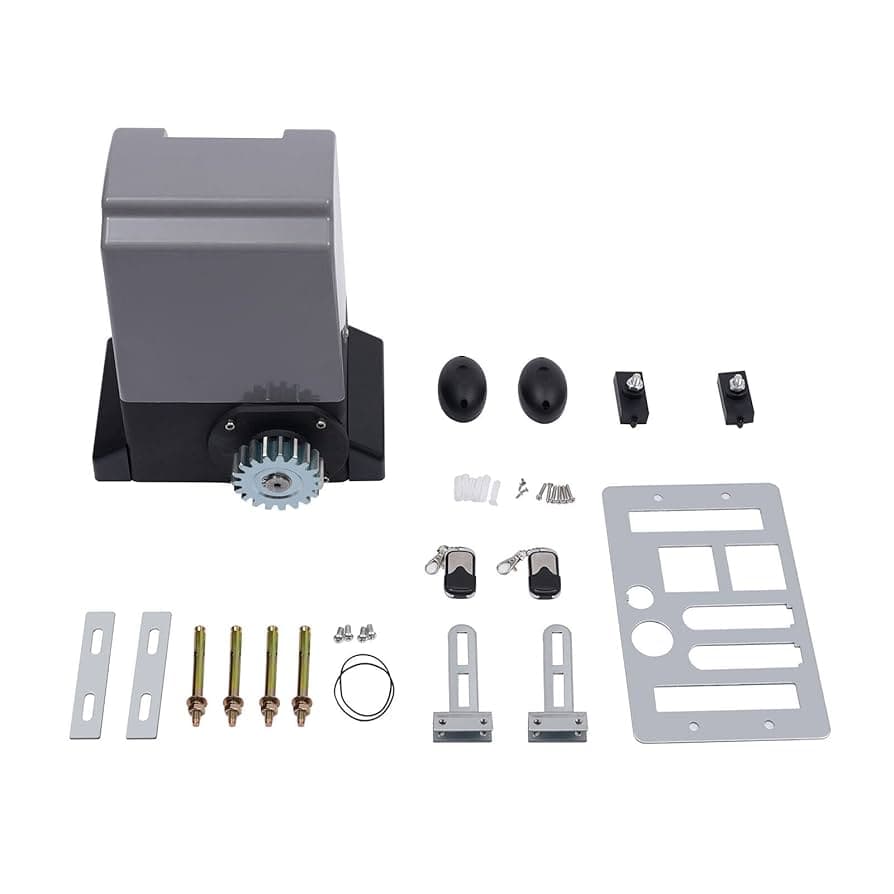
- Sliding kits: motor, 4 m gear rack, 2 remotes, 2 manual release keys, mobile controller and brackets. Everest includes a safety sensor; the Italian-designed kit has infrared sensors.
- Swing kit: motor arms, 2 remotes, a safety sensor, 2 manual keys and full mounting brackets.
Power cuts
Every kit has a manual release. During an outage you unlock the motor with the key and push the gate by hand, then lock it again when power returns. If outages are frequent where you live, choose the Everest DC motor, which works with a battery backup so the gate keeps running.
Safety with children and pets
A gate motor moves hundreds of kilograms, so safety sensors are not optional. The sensor sends an infrared beam across the gateway, and if a child, pet or car breaks the beam while the gate is closing, it stops. We test this with you at handover and show every family member how to use the manual release.
Warranty and upkeep
Everest Series motors carry a 3-year motor warranty. The Italian-designed and swing motors carry 5 years, and the swing kit includes 1 year of free servicing. To keep a sliding gate running smoothly, sweep stones and dirt off the track, keep the sensors clean, and call us if the gate becomes noisy or slow. Warranty does not cover physical damage.
Want a recommendation for your gate? Send us a photo with its rough size, or book a site visit through our gate automation service.