Most Nepali homes depend on a pump: to lift line water from an underground tank to the roof, to draw from a well or borewell, or to irrigate a field. Buying by horsepower alone is the most common mistake. This guide explains the two numbers that matter, head and flow, and which pump type fits each job.
The two numbers that matter
- Head is how high the pump can push water, in metres. Pump sheets list a rated head, where it works best, and a maximum head, where flow drops to almost nothing.
- Flow is how much water it moves, in m³/h (1 m³ is 1,000 litres) or litres per minute.
The two trade off against each other. A pump built for high head gives modest flow, and a pump built for high flow works at low head. Always pick a pump whose rated head comfortably exceeds the job.
Working out the head you need
Add the vertical height from the water level in your source to the top of the destination tank, then allow extra for pipe friction, bends and valves. A simple rule is to add about 20 to 30 percent. For example, lifting from an underground tank to a roof tank on a four-storey house might be 14 metres vertically; with friction you want a pump rated for at least 18 to 20 metres at the flow you need.
How long will it take to fill my tank?
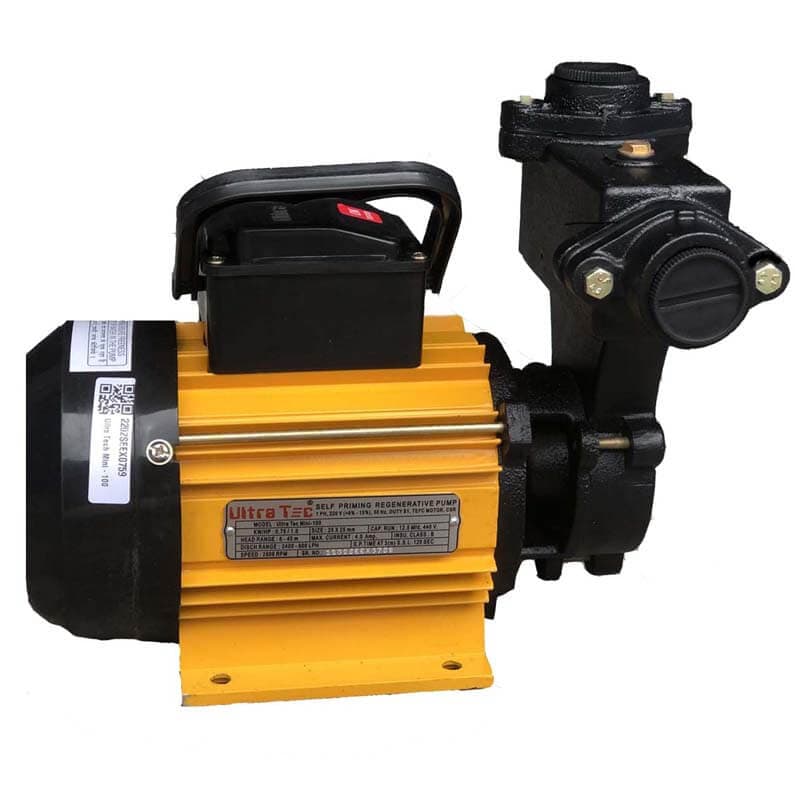
Divide tank size by flow. A pump delivering 1.5 m³/h at your working head fills a 1,000 L tank in about 40 minutes. Our ULTRATEC 1 HP self-priming pump, for instance, is rated at 1.5 m³/h at 25 metres head.
Pump types and what they are for
Self-priming pumps: lifting to the roof tank
The everyday household pump. It sits above ground and draws water from an underground tank or sump, then pushes it to the roof. Self-priming means it can clear air from the suction pipe by itself. A 0.5 HP model such as the Waterman Turbo 50 (14 m rated head) suits a two-storey house; 1 HP models like the ULTRATEC 1 HP or Waterman Power Gold 100 (22 m rated head) suit taller buildings.
Open-well submersible pumps
These sit underwater in an open well or a large tank, so they do not need to suck water up. The Waterman 1DHMS range, for example, reaches 21 m rated head on the 1 HP model.
Borewell submersible pumps
Slim, multi-stage pumps that go down a borewell, typically a 4-inch bore. Multiple stages let them push water from deep underground: our 1 HP Waterman borewell pump is rated at 62 metres head, and the 5 HP three-phase model at 44 metres rated head with 15.6 m³/h flow for larger supply.
Monoblock and lantern pumps: high flow for irrigation
Built for moving a lot of water a short height, such as from a canal, pond or river into a field. The Waterman Power 33MBC2.0 moves 33 m³/h at 10 m head, and the larger Shakti monoblocks go up to 68.4 m³/h. Lantern pumps with 2 to 4-inch outlets, like the OMAX O-L-CF range, do the same job for small farms.
Pressure boosters
Small pumps that raise water pressure from a roof tank to taps and showers, useful on top floors where gravity gives only a trickle.
Solar pumps and solar pump controllers
For farms without reliable grid power, a solar pump runs directly from solar panels during the day. A solar pump controller, or solar VFD, such as the Veikong range from 4 kW to 22 kW, converts panel output to drive a standard AC pump and adjusts speed as sunlight changes. They suit irrigation, where pumping during daylight is exactly when water is needed.
Single-phase or three-phase?
Most homes have single-phase 220V supply, which suits pumps up to about 2 HP. Larger monoblock and borewell pumps, such as the Shakti 3 HP and above or the Waterman 5 HP borewell, need a three-phase supply. Check your connection before choosing a larger pump.
Practical tips
- Never run a pump dry. A float switch, like the one on the OMAX stainless steel lantern pump, stops it automatically when the water runs low.
- Keep the suction pipe short, straight and airtight; most self-priming problems are suction leaks.
- Many pumps tolerate a wide voltage range, such as 170 to 230V on OMAX lantern pumps, which helps where supply is weak.
Compare head, flow and power for every model on the water pump price page, or contact us with your source, building height and tank size and we will pick the pump for you.